Weaponized Deepfakes Are Here: The Technical Anatomy of AI's Most Dangerous Output
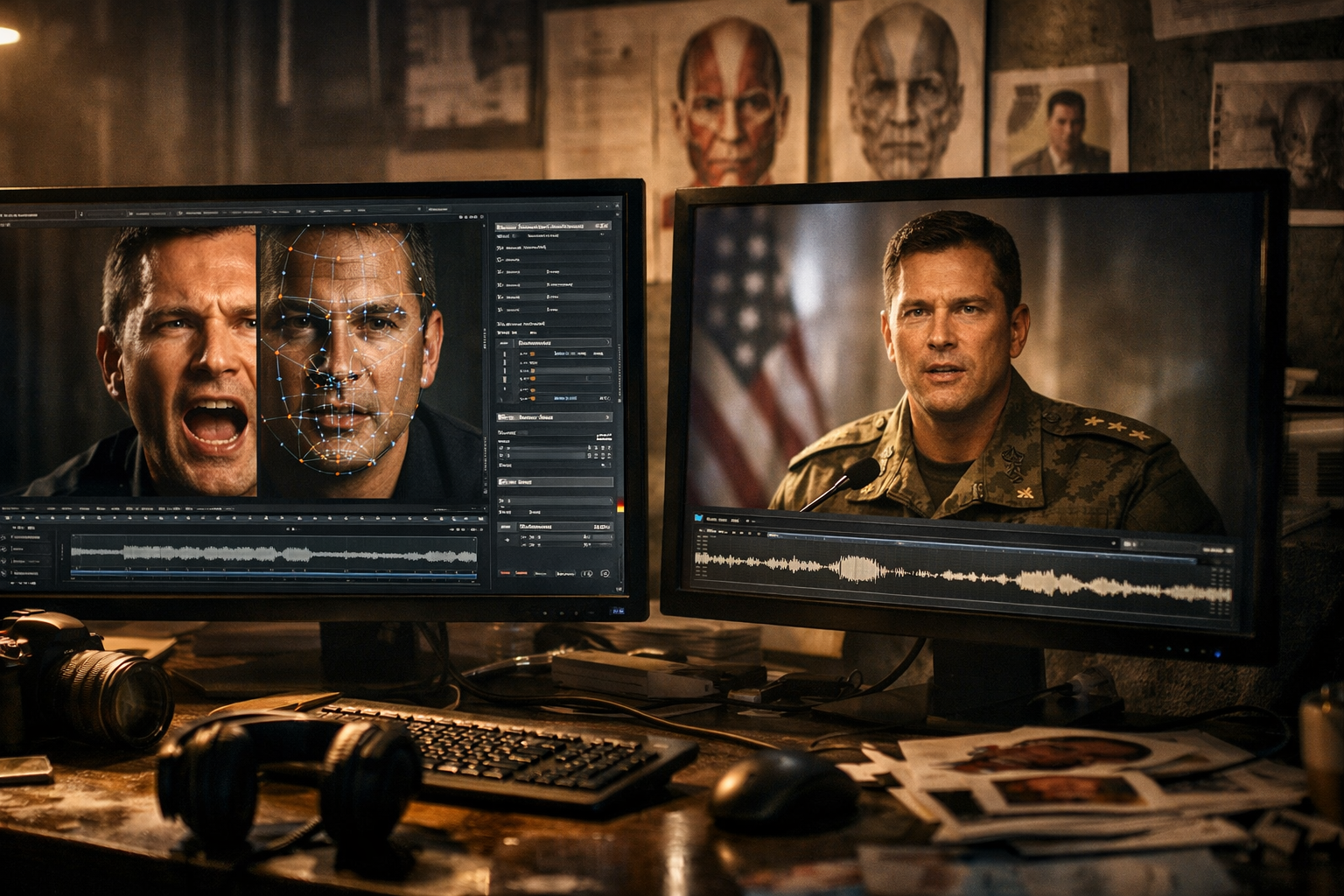
🤖 This article was AI-generated. Sources listed below.
The Threat Isn't Hypothetical Anymore
For years, deepfakes lived in a fuzzy zone between "impressive tech demo" and "looming catastrophe." That zone has collapsed.
MIT Technology Review's April 2026 report on the most important AI trends put it bluntly: weaponized deepfakes have arrived [¹]. The report specifically called out two alarming developments — Grok's mass generation of nonconsensual sexual images, and the US administration's use of AI-generated content for propaganda purposes. These aren't edge cases or dark-web experiments. They're mainstream deployments of generative AI being used to harm real people at scale.
This article isn't another hand-wringing op-ed about deepfakes being scary. Instead, let's pop the hood. What architectures power these systems? Why is detection so hard? And what does the technical arms race between generation and detection actually look like in 2026?
How Deepfakes Actually Work: A Technical Primer
If you've followed AI at all, you've probably heard terms like "GANs" and "diffusion models" thrown around. But the deepfake landscape in 2026 is more nuanced — and more capable — than most people realize.
The Three Pillars of Modern Deepfake Generation
1. Diffusion Models (The Current King)
The dominant architecture behind today's most convincing image deepfakes is the latent diffusion model — the same family of models that powers Stable Diffusion, DALL-E, and Midjourney. Here's the simplified version:
- Start with pure noise (random pixel data)
- Train a neural network to gradually denoise that image, step by step, until it matches a target distribution
- Condition the denoising process on text prompts, reference images, or both
- The "latent" part means this all happens in a compressed mathematical space (the latent space), not pixel-by-pixel — which makes it dramatically faster
The key insight: these models don't "copy" existing images. They learn the statistical distribution of what faces, bodies, and scenes look like, then sample new outputs from that distribution. This makes them incredibly hard to catch with simple reverse-image-search approaches.
2. Face-Swap Networks (The OG Deepfake)
The original deepfake technique — encoder-decoder networks that learn to map one person's facial expressions onto another person's face — is still alive and evolving. Modern face-swap systems use:
- Autoencoders with shared encoders but separate decoders for source and target faces
- Attention mechanisms borrowed from transformer architectures to better preserve fine details (hair strands, skin texture, lighting)
- Temporal consistency modules that ensure video deepfakes don't "flicker" between frames
3. Voice Cloning + Lip Sync (The Full Package)
A convincing video deepfake in 2026 typically combines:
- A voice cloning model (often transformer-based, needing as little as 3-15 seconds of reference audio)
- A lip-sync model that generates mouth movements matching the cloned speech
- A face-swap or full-body generation model for the visual component
The result: a pipeline that can produce a video of anyone saying anything, often in near-real-time.
Why 2026 Is Different: The Scale Problem
Deepfakes have existed since 2017. So why is MIT Technology Review sounding the alarm now?
The answer is scale and accessibility.
The models that topped benchmarks six months ago now rank in the middle of the pack, according to the same MIT Technology Review analysis [¹]. AI is advancing in reasoning depth, multimodal understanding, and raw efficiency at a pace that makes yesterday's state-of-the-art feel like a first draft.
Applied to deepfakes, this means:
- Generation time has plummeted. What took minutes per image in 2024 takes seconds in 2026. What took hours per video minute now takes minutes.
- Quality floors have risen. Even low-effort deepfakes are now convincing enough to fool casual viewers.
- Access has democratized. Open-source models, API endpoints, and consumer-grade GPUs have put Hollywood-quality generation capabilities into the hands of anyone with a laptop.
The concern isn't just that deepfakes exist — it's that they can be produced at industrial scale by individuals, companies, and governments alike.
When a platform like Grok enables mass generation of nonconsensual sexual imagery [¹], the bottleneck isn't technical capability — it's the deliberate choice (or failure) to implement guardrails.
The Detection Arms Race: Why It's an Asymmetric War
So if generation is getting this good, what about detection? Here's where things get technically fascinating — and deeply sobering.
Current Detection Approaches
Forensic Classifiers
The most common approach: train a binary classifier (real vs. fake) on large datasets of authentic and synthetic media. Modern versions use:
- Vision transformers (ViTs) that analyze image patches for statistical anomalies
- Frequency-domain analysis — synthetic images often have subtle artifacts in their Fourier transforms that human eyes can't see but neural networks can detect
- Biological signal detection — real video contains micro-signals like pulse-induced skin color changes and natural blink patterns that deepfakes often miss
Provenance-Based Systems
Rather than detecting fakes after the fact, these systems try to authenticate originals:
- C2PA (Coalition for Content Provenance and Authenticity) embeds cryptographic signatures into media at the point of capture
- Watermarking — invisible watermarks baked into AI-generated content by the generating model itself
- Blockchain-based verification chains that track media from camera to publication
Why Detection Is Losing
Here's the brutal asymmetry:
- Generators improve faster than detectors. Every improvement in generation quality automatically degrades detector performance. Detectors must be retrained; generators just need to be... better.
- Adversarial attacks are trivial. Adding tiny, imperceptible perturbations to a deepfake image can flip a detector's classification from "fake" to "real" with high confidence. This is a well-understood vulnerability in classifier networks.
- Compression destroys evidence. When deepfake images are shared on social media, platforms compress and re-encode them — stripping away many of the subtle artifacts that forensic detectors rely on.
- Watermarks can be removed. Research has shown that most current watermarking schemes can be defeated through simple image transformations (cropping, re-encoding, adding noise) without visibly degrading the image.
The detection accuracy numbers tell the story: Top forensic classifiers achieve 90-95% accuracy on the datasets they're trained on, but that number drops precipitously — sometimes to 60-70% — when confronted with deepfakes from architectures they haven't seen before. This is the generalization problem, and it remains unsolved.
The Guardrail Question: Technical Choices With Moral Weight
The MIT Technology Review report highlights something crucial: the deepfake crisis isn't purely a technical problem. It's a design choice problem [¹].
Every generative AI system includes (or excludes) safety mechanisms:
- NSFW classifiers that screen outputs before delivery
- Prompt filters that block requests for specific individuals or explicit content
- RLHF (Reinforcement Learning from Human Feedback) training that steers models away from harmful outputs
- Identity-specific blocklists that prevent generation of known public figures
The fact that some platforms have deployed these guardrails effectively while others haven't isn't a technological limitation — it's a policy decision embedded in engineering.
The Architectural Tension
There's a genuine technical tension here that's worth understanding:
- Tighter guardrails reduce model capability. Aggressive NSFW filtering can block legitimate artistic, medical, or educational content. Overzealous prompt filtering makes models less useful for benign tasks.
- Open-source models can't be controlled post-release. Once model weights are published, anyone can fine-tune away safety restrictions. This is the fundamental challenge with open-weight release strategies.
- Efficiency gains help attackers too. The same advances in raw efficiency that make AI more accessible for positive uses also lower the barrier for weaponized applications.
This isn't a problem you can solve with a better algorithm. It requires a combination of technical architecture, platform policy, and legal frameworks — which is exactly the kind of multi-layered response that's hardest to coordinate.
What's Actually Working (And What Isn't)
Let's be honest about the state of play:
✅ Showing Promise
- Provenance standards (C2PA) are gaining adoption among major camera manufacturers and news organizations. If you can prove an image is authentic, you don't need to prove a fake is fake.
- Real-time detection APIs are getting faster, making it feasible to screen uploads at platform scale.
- Multimodal consistency checking — cross-referencing audio, video, and text for inconsistencies — is proving more robust than single-modality detection.
❌ Not Working Yet
- Post-hoc detection as a standalone solution. The arms race dynamics make this a losing game long-term.
- Voluntary industry self-regulation. The Grok example demonstrates that market incentives don't reliably produce safety [¹].
- Legal frameworks. Laws targeting deepfakes exist in some jurisdictions but enforcement lags dramatically behind production.
The Bigger Picture: When AI Becomes a Weapon Against Truth
The deepfake crisis connects to a broader pattern that's visible across multiple domains in 2026.
Consider the parallel: ProPublica recently reported that a fossil fuel industry-funded center has been hosting symposiums to educate judges about free-market views of climate science [²]. Meanwhile, a Tunis court will examine a request on May 11 to dissolve the association running investigative outlet Inkyfada, raising serious press freedom concerns [³]. And investigative journalist Shibani Mahtani — who just won the 2026 Shorenstein Journalism Award for her investigations into repression in Hong Kong [⁴] — represents exactly the kind of accountability journalism that weaponized deepfakes could undermine.
The through-line is clear: the institutions that verify truth — courts, newsrooms, independent journalists — are under pressure from multiple directions simultaneously. Weaponized deepfakes add a powerful new tool to that pressure arsenal.
When any video can be faked, every video can be denied. This is what researchers call the "liar's dividend" — the idea that the mere existence of deepfake technology lets bad actors dismiss authentic evidence as fabricated.
What Intermediate-Level Practitioners Should Know
If you're working in AI, building products, or making decisions about AI deployment, here are the technical takeaways that matter:
Detection is necessary but insufficient. Don't build systems that rely solely on classifying content as real or fake. Layer provenance, context, and behavioral signals.
Guardrails are architecture, not afterthoughts. Safety mechanisms need to be designed into model training pipelines, not bolted on post-deployment.
The generalization problem is the key research frontier. If you're in ML research, cross-architecture deepfake detection — models that can identify fakes from generators they've never seen — is one of the highest-impact open problems.
Think about your threat model. A deepfake targeting a private individual (nonconsensual imagery) requires different countermeasures than one targeting an election (political propaganda). Design accordingly.
Efficiency gains are double-edged. Every optimization that makes your model faster and cheaper also makes weaponized versions faster and cheaper. Factor this into release decisions.
The Bottom Line
Weaponized deepfakes aren't a future threat — they're a current reality that MIT Technology Review has identified as one of the defining AI developments of 2026 [¹]. The technical architectures powering them (diffusion models, face-swap networks, voice cloning pipelines) are mature, efficient, and increasingly accessible. Detection technology is improving but fundamentally disadvantaged in the arms race. And the most important "technical" decisions are often policy decisions wearing engineering clothes.
The AI community built these tools. The AI community needs to be honest about what they've unleashed — and relentless about building the countermeasures.