The Strait of Hormuz Is Closed by Drones. AI Was Supposed to Prevent This. What Happened?
🤖 This article was AI-generated. Sources listed below.
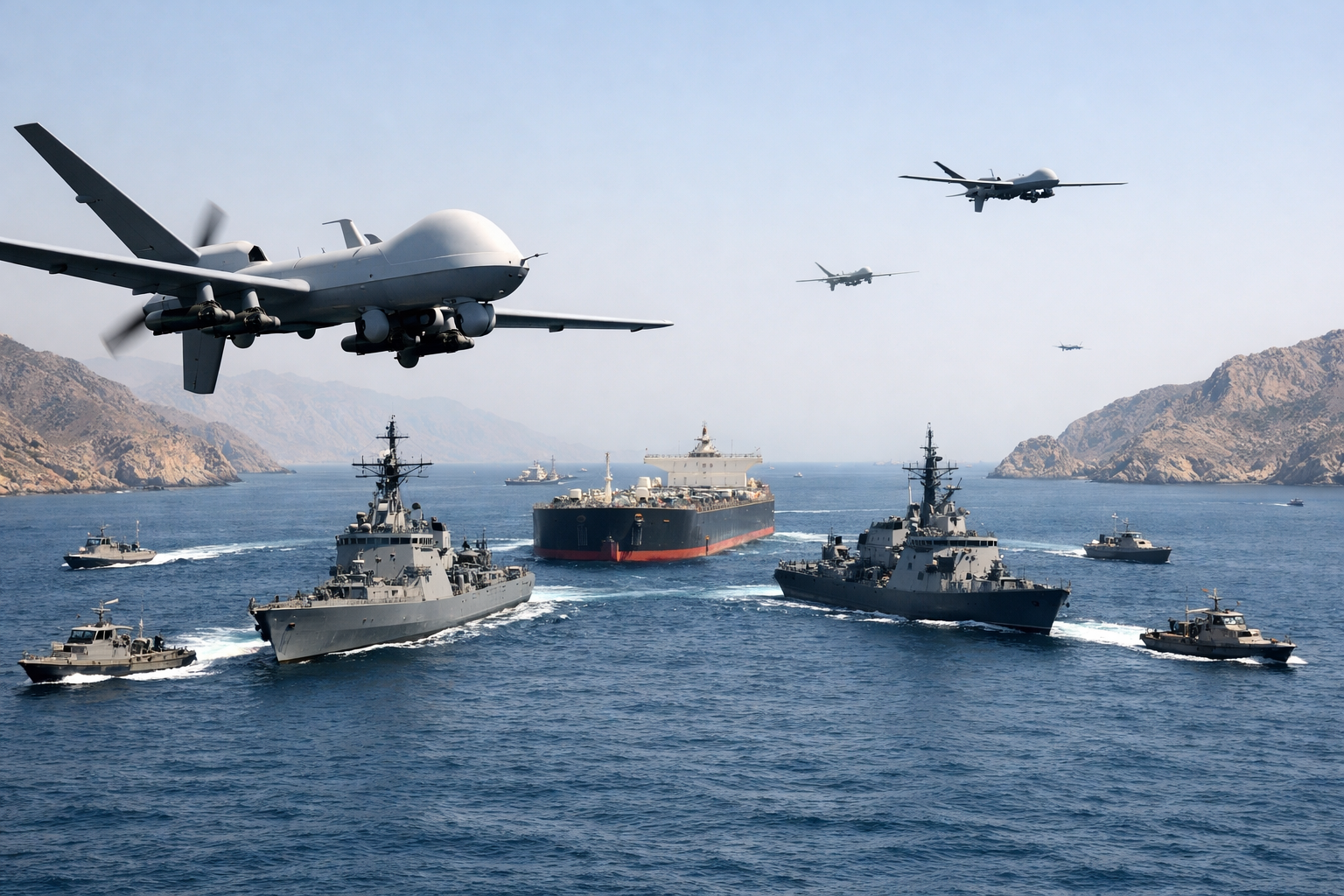
Here's a scene that should haunt every AI optimist: the Strait of Hormuz — the narrow waterway through which roughly 20% of the world's oil flows — has been effectively shut down by Iran using a swarm of cheap drones, fast-attack speedboats, and sea mines [¹]. The US Navy, the most technologically advanced naval force in human history, still hasn't been able to reopen it.
| Topic | Detail |
|---|---|
| What happened | Iran has effectively closed the Strait of Hormuz using drones, speedboats, and sea mines |
| Why it matters | ~20% of the world's oil flows through the Strait; closure spikes energy prices and tests AI-enabled defense promises |
| The AI angle | Billions invested in AI-powered defense systems have not prevented or resolved the crisis |
| Key tension | Gap between AI demo performance and real-world, adversarial conditions |
| Public sentiment | Majority of Americans oppose escalation; consumer confidence is declining |
Let that sit for a moment.
For years, the defense-tech world has been awash in AI promises. Autonomous threat detection. AI-powered drone countermeasures. Predictive analytics for naval warfare. Billions of dollars have flowed into defense-tech companies building the so-called "AI-enabled battlefield." In my reading, the Pentagon's own AI strategy documents often read like Silicon Valley pitch decks — full of words like "decision advantage" and "sensor fusion" and "kill chains."
And yet here we are. A determined adversary with comparatively primitive technology has turned one of the planet's most important shipping lanes into a no-go zone.
The Swarm Problem AI Hasn't Solved
The core challenge in the Strait of Hormuz isn't one AI can't theoretically address — it's one that exposes the gap between lab performance and battlefield chaos. Drone swarms are a nightmare for traditional defense systems because they exploit a fundamental asymmetry: a cheap commercial drone can force an advanced destroyer to expend an expensive interceptor missile. Do the math on that exchange rate a few hundred times — the economics overwhelmingly favor the attacker.
AI-powered counter-drone systems exist, and some work impressively in controlled tests. But the Hormuz scenario stacks problems that AI still struggles with:
- Cluttered environments: The Strait is packed with civilian shipping, fishing boats, and commercial aircraft. An AI system needs to distinguish a hostile drone from a fishing skiff's radar signature in a sandstorm, at night, while being electronically jammed. That's a much harder problem than any demo reel suggests.
- Electronic warfare degradation: Iran has invested heavily in GPS jamming and spoofing. Many AI-powered defense systems rely on precise sensor data that degrades rapidly under electronic attack.
- Mines are dumb on purpose: Sea mines are essentially the anti-AI weapon. They sit. They wait. They don't emit signals to detect. AI-powered mine countermeasures are improving, but clearing a minefield in contested waters remains agonizingly slow and dangerous.
"Iran has effectively closed the Strait of Hormuz… with a combination of drones, speedboats, and mines, and the United States Navy still cannot reopen the waterway." — The New York Times, Opinion [¹]
This Isn't Just a Military Problem — It's an AI Honesty Problem
Here's where I want to take a clear stance: the Hormuz crisis is a referendum on AI hype culture, not just defense policy.
The pattern is painfully familiar. An industry makes sweeping promises about what AI will do. Money floods in. Demos look spectacular. And then reality — messy, adversarial, unpredictable reality — punches those promises in the mouth.
In my view, we've seen echoes of this pattern across sectors — from autonomous driving stumbles to healthcare AI underdelivering on early promises to content moderation falling short despite massive investment. These are my general observations rather than empirically documented parallels, but the defense sector strikes me as the latest — and highest-stakes — example.
The defense AI companies aren't frauds. Many are building genuinely impressive technology. But there's a dangerous gap between "our system works in testing" and "our system works when an adversary is actively trying to make it fail." That gap is where people die, where oil prices spike, and where public trust in both the military and AI erodes.
The Counterargument: AI Needs Time, Not Blame
To be fair, blaming AI for the Hormuz situation is a bit like blaming the internet for not preventing 9/11 — though the analogy is imperfect, since AI defense systems were specifically pitched as counters to asymmetric threats like drone swarms, whereas the internet was never promised as a counterterrorism tool. Still, AI-powered defense systems are still maturing. The Navy's integration of autonomous systems has been hampered by bureaucratic procurement processes, risk-averse leadership, and legitimate concerns about autonomous weapons.
Defenders of the defense-AI ecosystem would argue — with some justification — that the problem isn't the technology but the speed of adoption. The Pentagon is still flying some aircraft designed in the 1970s. You can't bolt AI onto a Cold War-era fleet and expect miracles.
And they'd be right that asymmetric threats like drone swarms are genuinely novel challenges that no technology, AI or otherwise, has fully solved yet.
But that's exactly the point. If the technology isn't ready, the industry shouldn't be selling certainty. And the 3-in-5 Americans who now oppose the Iran war [³] aren't going to be patient with explanations about procurement timelines.
The Lesson for All of AI
The Hormuz situation carries a lesson that extends well beyond defense: AI works best when its limitations are acknowledged upfront, not discovered in crisis.
Every sector deploying AI — healthcare, finance, education, criminal justice — should look at the Strait of Hormuz and ask: Where are we making promises our systems can't keep in adversarial conditions? Where are we optimizing for demo performance instead of real-world resilience? Where have we confused "AI-powered" with "problem solved"?
Broader economic confidence appears to be eroding [⁴]. Public trust in institutions is fragile. The AI industry cannot afford to become yet another sector where the gap between promises and reality breeds cynicism.
The Strait of Hormuz isn't just a geopolitical crisis. It's a $500-drone-shaped mirror being held up to a multi-billion-dollar industry. And right now, the reflection isn't flattering.
Sources
- Opinion | The Tragic Decline of the American Navy - The New York Times
- Opinion | May Day 2026: What Kind of Nation Will This Be? | Common Dreams
- Americans' disapproval of the war in Iran reaches Vietnam-era levels, poll finds
- US consumers don't live in Trump's fantasy economy | Baltimore Sun
- Early Edition: May 1, 2026 - Just Security
- Appendix: Additional charts | Pew Research Center