Should Governments Ban Autonomous AI Weapons — Or Is It Already Too Late to Try?
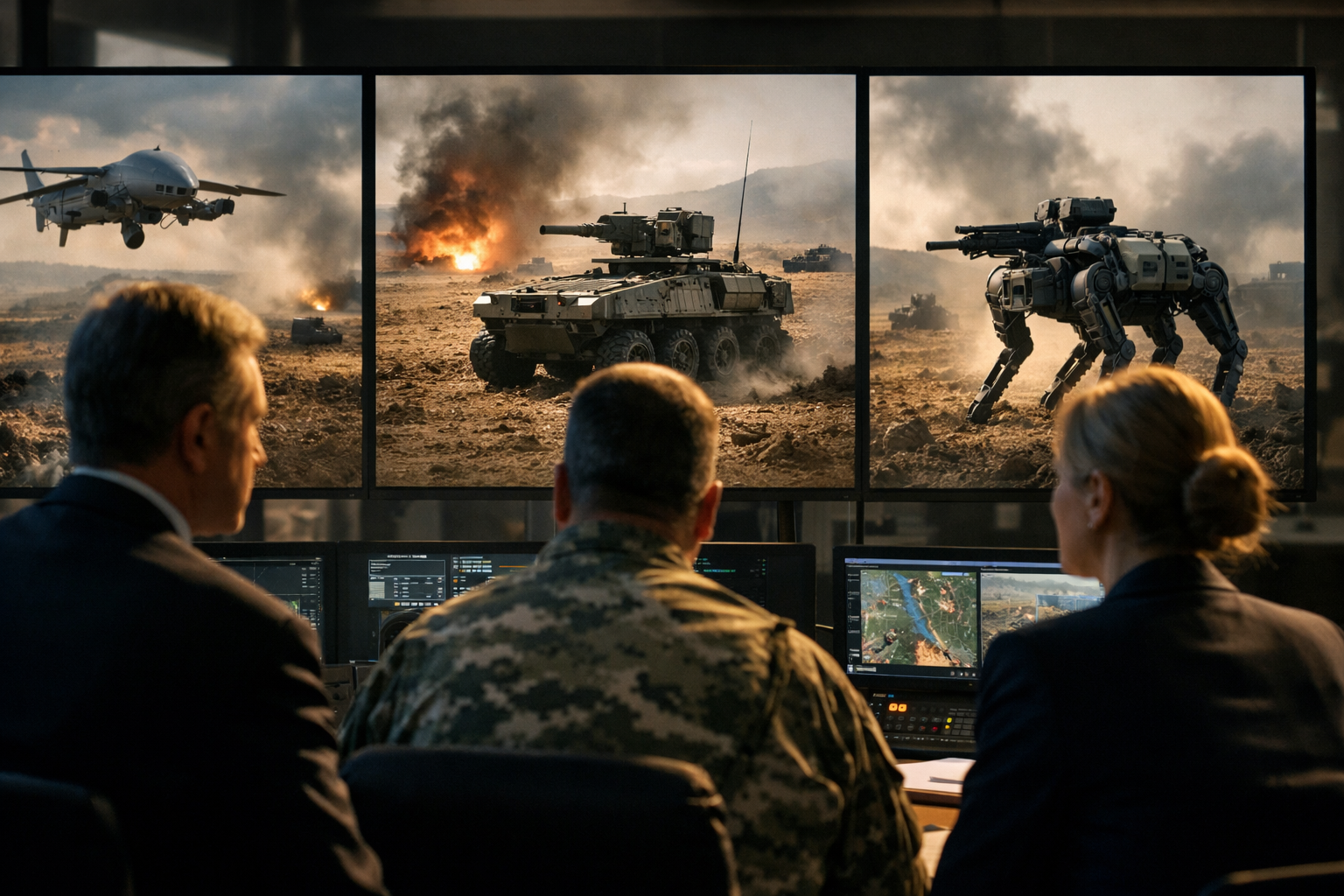
🤖 This article was AI-generated. Sources listed below.
The Controversy Nobody Can Afford to Ignore
Somewhere between the breathless hype about AI assistants and the latest model benchmark drama, there's a conversation happening that could literally determine whether humans live or die — and most of us aren't paying enough attention to it.
Lethal Autonomous Weapons Systems (LAWS) — weapons that can select and engage targets without a human pulling the trigger — are no longer science fiction. They're being developed, tested, and in some cases deployed right now. And the global community is deeply, bitterly divided on what to do about it.
The United Nations has been hosting discussions on LAWS through the Convention on Certain Conventional Weapons (CCW) since 2014. More than a decade later, there's still no binding international agreement. [¹] In 2023, the UN General Assembly adopted its first resolution on autonomous weapons, calling for urgent action, but it was non-binding. [²] Meanwhile, militaries around the world keep building.
As of May 2026, the debate has only intensified. The rapid advancement of AI foundation models, the proliferation of cheap drone technology, and real-world conflicts showcasing autonomous systems have turned a theoretical argument into an existential one — existential not in a vague sense, but for the viability of international arms control frameworks and, ultimately, for civilian safety in future conflicts.
Let's hear from both sides.
| Side A: Pro-Ban | Side B: Anti-Ban | |
|---|---|---|
| Core Claim | A preemptive, legally binding global ban on fully autonomous lethal weapons is a moral and strategic imperative. | A ban is unenforceable, definitionally impossible, and could leave democracies at a strategic disadvantage. |
| Strongest Point | Machines must not make life-and-death decisions; human dignity requires a human in the loop. | The underlying technology is dual-use and freely available — you can't effectively ban software. |
| Biggest Weakness | Enforcement and definitional challenges are massive; adversaries likely won't comply. | The "AI is more humane" argument doesn't match the error-prone, bias-laden AI systems we actually have today. |
| Our Recommendation | A layered approach: establish a strong international norm against fully autonomous killing, mandate meaningful human control over lethal force, invest in verification technology, implement export controls, and demand radical transparency — before the technology outruns governance entirely. |
🟢 Side A: "We Need a Preemptive Global Ban — Now"
The Core Argument
Proponents of a ban argue that allowing machines to make life-and-death decisions crosses a fundamental moral line — one that, once crossed, can never be uncrossed. They want a legally binding international treaty, similar to the bans on chemical weapons and anti-personnel landmines, that prohibits fully autonomous lethal systems before they become entrenched in military doctrine.
The Strongest Points
The moral red line. No algorithm, no matter how sophisticated, should decide who lives and who dies. Human dignity demands a human in the loop. The International Committee of the Red Cross (ICRC) has called for new legally binding rules, arguing that autonomous weapons raise "fundamental ethical concerns" about replacing human decisions in matters of life and death. [³]
Accountability gaps. If an autonomous weapon commits a war crime, who is responsible? The programmer? The commanding officer? The defense contractor? Current international humanitarian law is built around human decision-makers. Remove the human and the entire framework collapses.
"Machines should not be making decisions about who to kill. Period. There is no algorithm for human dignity." — Bonnie Docherty, Associate Professor, Harvard Law School and Senior Researcher, Human Rights Watch [⁴]
Arms race dynamics. Without a ban, we're headed for an AI arms race that makes the nuclear standoff look quaint. Nuclear weapons required massive state investment and rare materials. Autonomous weapons can be built with commercially available drones and open-source AI. The barrier to entry is terrifyingly low.
Precedent works. The 1997 Mine Ban Treaty didn't achieve universal adoption, but it created a powerful global norm that dramatically reduced the production and use of landmines. A LAWS ban could do the same — even without every nation signing on. [⁵]
Proliferation to non-state actors. Cheap autonomous weapons won't stay in the hands of responsible militaries. They'll end up with terrorist groups, cartels, and authoritarian police states. A ban creates legal infrastructure to prosecute misuse.
🔴 Side B: "A Ban Is Naive, Unenforceable, and Dangerous"
The Core Argument
Opponents of a ban argue that autonomous weapons are an inevitable extension of existing military technology, that banning them would be practically impossible to enforce, and that — counterintuitively — AI-powered weapons could actually reduce civilian casualties compared to panicked, exhausted, or biased human soldiers.
The Strongest Points
You can't ban math. Unlike chemical weapons or nuclear material, the core technology behind autonomous weapons is dual-use software that's freely available. You'd essentially be trying to ban a specific application of algorithms that are used in everything from self-driving cars to warehouse logistics. Verification is nearly impossible.
Democracies would comply; adversaries wouldn't. A ban creates an asymmetric disadvantage. Countries like the U.S., UK, and EU member states would likely follow the rules. Countries like Russia, China, and North Korea — which have shown little interest in such agreements — would not. The result: the world's democracies would be less capable of defending themselves and their allies.
"A preemptive ban on autonomous weapons systems risks being both unverifiable and strategically destabilizing. We should focus on meaningful human control, not blanket prohibitions." — Paul Scharre, author of Army of None and Executive Vice President, Center for a New American Security [⁶]
AI could reduce civilian casualties. A well-designed autonomous system doesn't get scared, angry, or vengeful. It doesn't commit atrocities out of rage. It can be programmed with strict rules of engagement and target identification protocols that exceed what human soldiers achieve under fire. Banning autonomous weapons could mean more civilian deaths, not fewer. This is a commonly cited theoretical argument among defense policy analysts, not a conclusion established by empirical research on deployed autonomous systems.
The spectrum problem. Where do you draw the line? Missile defense systems like Israel's Iron Dome already make autonomous engagement decisions — they have to, because humans can't react fast enough. Are those banned? What about autonomous cyber-defense systems? Smart mines? The definitions are impossibly fuzzy. [⁷]
Regulation beats prohibition. Instead of a ban that won't work, invest in robust regulatory frameworks: require meaningful human control, establish testing and certification standards, create international inspection regimes. Work with the technology rather than pretending it doesn't exist.
⚖️ Where It Stands in 2026
The landscape is shifting fast:
- Over 100 countries have participated in the UN CCW discussions, but consensus has been blocked repeatedly, largely by the U.S., Russia, and a handful of other major military powers. [¹]
- Austria, Costa Rica, and a coalition of smaller nations have been pushing for a standalone treaty process outside the CCW, frustrated by the consensus requirement that lets any single nation stall progress. [⁸]
- The conflict in Ukraine has been a real-world proving ground for increasingly autonomous drone systems, accelerating development timelines and making the conversation feel far less hypothetical. [⁹]
- AI leaders have weighed in. Thousands of AI researchers signed an open letter in 2023 calling for international action. More recently, several prominent AI researchers and organizations have continued to advocate for governance frameworks. [¹⁰]
- The U.S. Department of Defense updated its directive on autonomous weapons (DoD Directive 3000.09) in 2023, requiring that autonomous and semi-autonomous weapons be designed to allow human judgment in the use of force. [¹¹]
🎤 Our Take
Here's the uncomfortable truth: both sides are right about the other side's weaknesses.
The ban advocates are correct that crossing the threshold of fully autonomous killing is a moral Rubicon. The accountability vacuum is real. The proliferation risk is terrifying. And the "AI would be more humane" argument, while intellectually interesting, rests on a fantasy version of AI that doesn't match the error-prone, bias-laden, hallucination-having systems we actually have in 2026.
But the anti-ban camp is right that a simple prohibition is almost certainly unenforceable. The definitional challenges are massive. And unilateral restraint by democracies while authoritarian states charge ahead is a genuinely dangerous proposition.
So where does that leave us?
We think the answer is a layered approach:
- A clear international norm — even if not universally adopted — that stigmatizes fully autonomous lethal systems the way chemical weapons are stigmatized. Norms matter, even when they're imperfect.
- Binding requirements for meaningful human control over any system that can apply lethal force. Not a rubber-stamp "human on the loop" who can theoretically override a decision in 0.3 seconds, but genuine, substantive human judgment.
- Aggressive investment in verification technology. If we can build autonomous weapons, we can build systems to detect and monitor them.
- Export controls and proliferation frameworks to keep the most dangerous capabilities out of the hands of non-state actors.
- Radical transparency from democracies about their own programs, to build trust and set standards.
The worst possible outcome isn't choosing the wrong side of this debate. It's continuing to have the debate for another decade while the technology races past our ability to govern it. The CCW process has been running since 2014 with essentially nothing to show for it. That's not diplomacy — it's stalling.
The drones are already flying. The algorithms are already deciding. The question isn't whether we'll have autonomous weapons. It's whether we'll have any rules at all when we do.
Sources
- UN Convention on Certain Conventional Weapons - Group of Governmental Experts on LAWS
- UN General Assembly First Committee Resolution on Autonomous Weapons (2023)
- ICRC Position on Autonomous Weapon Systems
- Human Rights Watch - Killer Robots Campaign
- International Campaign to Ban Landmines - Mine Ban Treaty
- Paul Scharre - Center for a New American Security
- Iron Dome and Autonomous Decision-Making in Missile Defense
- Austria-led Push for Autonomous Weapons Treaty
- Autonomous Drones in the Ukraine Conflict
- Open Letter on Autonomous Weapons - Future of Life Institute
- DoD Directive 3000.09 - Autonomy in Weapon Systems (2023 Update)