Gradient Descent: How AI Finds the Best Answer by Stumbling Downhill in the Dark
🤖 This article was AI-generated. Sources listed below.
The Big Question: How Does AI Actually Get Better?
When someone tells you an AI model was "trained," your brain probably conjures images of a robot doing homework. But what's really happening under the hood is both simpler and stranger than that. The secret sauce is a mathematical process called gradient descent — and once you understand it, the entire world of AI clicks into place.
Let's break it down with zero math and maximum metaphor.
Imagine You're Blindfolded in a Valley
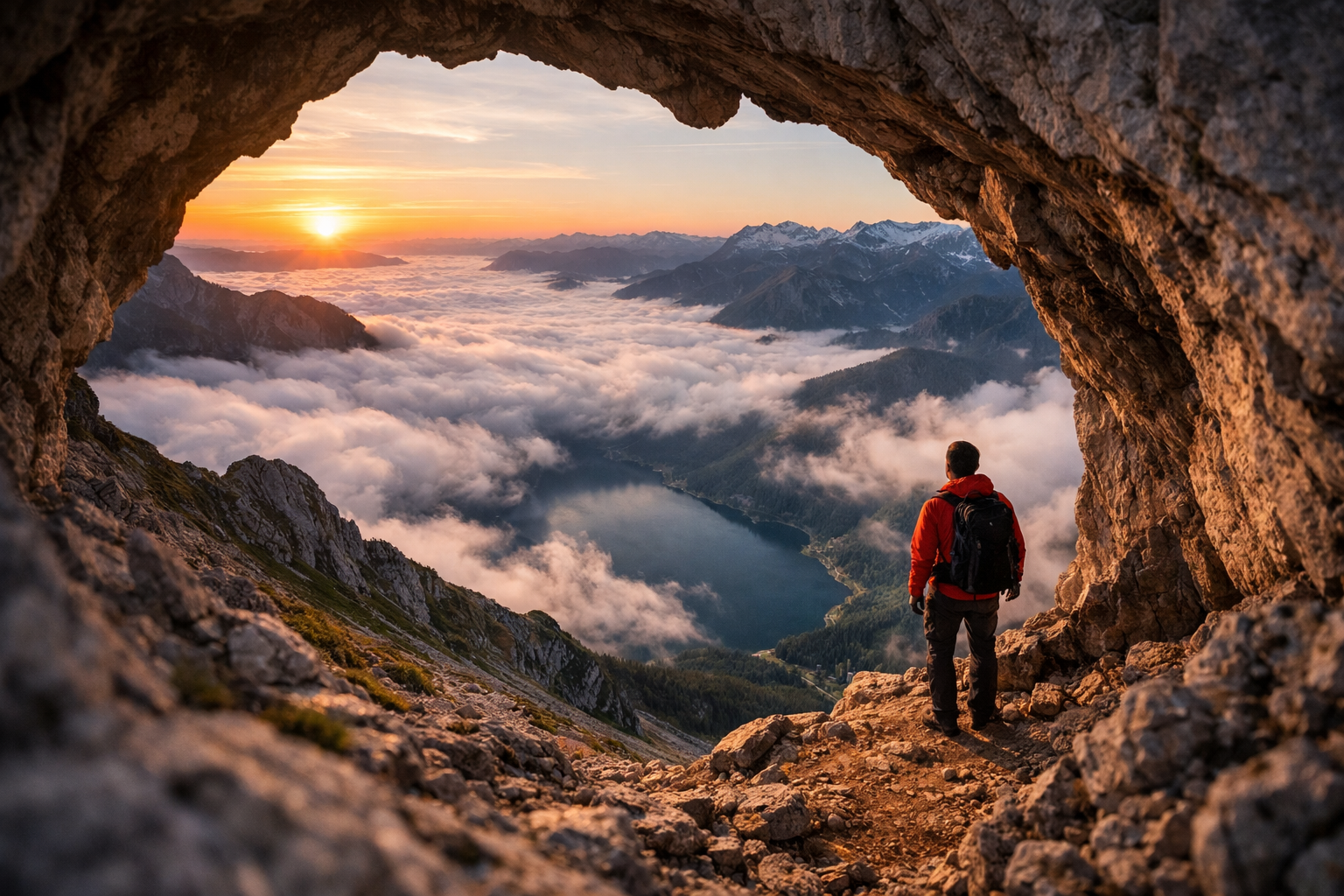
Picture this: you're dropped into a massive, hilly landscape — think the rolling hills of Tuscany, but pitch black and you can't see a thing. Your only goal? Get to the lowest point in the valley. That lowest point represents the best possible answer an AI can give.
You can't see, but you can feel the ground beneath your feet. So you do the only logical thing: you feel which direction slopes downward, and you take a step that way. Then you feel again. Step again. Over and over.
That's gradient descent in a nutshell. The "gradient" is the slope you're feeling — mathematically, it tells the AI which direction "down" is. The "descent" is the stepping. The AI inches toward a better answer one tiny adjustment at a time.[¹]
Now Add a River
Here's where the analogy gets richer. Think about how a river carves a path through a mountain range. Water doesn't "decide" to find the ocean — it just follows gravity, always moving downhill, always finding the path of least resistance. Over time, that mindless process carves the Grand Canyon.[²]
Gradient descent works the same way. The AI doesn't "understand" its task. It just follows the mathematical slope downhill, adjusting its internal settings — called weights — a tiny bit with each step. Over millions of steps, those mindless adjustments carve out something remarkable: a model that can write poetry, diagnose diseases, or recognize your cat in a photo.
The Step Size Problem: When You Overshoot the Valley
There's a catch. How big should each step be?
If your steps are too big, you'll leap right over the lowest point and end up bouncing back and forth across the valley like a pinball. If your steps are too small, you'll technically get there… in about ten thousand years. AI researchers call this step size the learning rate, and tuning it is one of the most important (and finicky) parts of training a model.[³]
Think of it like adjusting the volume on a speaker. Too high and everything distorts. Too low and nobody can hear the music. The sweet spot is where the magic happens.
What About Fake Valleys? (The Local Minimum Trap)
Remember our Tuscan landscape? What if it has multiple dips — not just one big valley, but dozens of smaller ones? Your blindfolded self might stumble into a shallow dip and think, "I made it! This is the bottom!" But the real lowest point is three hills over.
In AI, these shallow dips are called local minima, and the true lowest point is the global minimum. Modern AI training uses clever tricks — like adding a bit of randomness to each step, or using momentum (imagine giving yourself a running start so you roll right through shallow dips) — to avoid getting stuck.[⁴]
It's like shaking a pinball machine just enough to keep the ball moving without tilting it.
Why Should You Care?
Gradient descent isn't just an obscure algorithm — it's the engine behind virtually every AI breakthrough you've heard about. Every chatbot response, every AI-generated image, every medical diagnosis model got good at its job because gradient descent nudged millions of tiny dials in the right direction, one step at a time.[⁵]
Understanding this concept reframes the entire AI conversation. When someone says a model is "learning," it's not gaining consciousness — it's stumbling downhill in the dark, feeling for the slope, and taking another step. When a model gives a wrong answer, it's not being "stupid" — it might just be stuck in a local minimum, or its learning rate was off.
The Takeaway
The next time you hear about an AI model that can do something jaw-dropping, remember the river. It didn't decide to carve the Grand Canyon. It just followed gravity, one moment at a time, until something extraordinary emerged from something almost absurdly simple.
Gradient descent is that gravity. It's not glamorous. It's not mysterious. But it is the single most important optimization process in modern AI — and now you understand it well enough to explain it at a dinner party, a job interview, or to your skeptical uncle at Thanksgiving.
Welcome to the valley. Start walking downhill.
Sources
- Gradient Descent, Step-by-Step — StatQuest with Josh Starmer (YouTube)
- Andrej Karpathy, Neural Networks: Zero to Hero lecture series (YouTube)
- How Rivers Shape Landscapes — National Geographic Education
- An Overview of Gradient Descent Optimization Algorithms — Sebastian Ruder
- Escaping Local Minima in Deep Learning — Towards Data Science
- Gradient-Based Learning Applied to Document Recognition — Yann LeCun et al., Meta AI Research